
One of the main questions I'm asked about sustainable home design is "what sort of windows do I choose? Is double glazing the only choice?"
Some basics are needed first to help understand the differing needs for glazing – advice that is unfortunately lacking among glazing retailers here (or so I found when product sourcing 2 years ago).
There are 3 types of heat transfer:
- Radiant is when the light itself hits something and warms it up. The visible light band is absorbed by that thermal body and re-emitted as long-wave or infra-red light, or put simply: heat.
- Conducted is where a body is heated on one side and conducts that heat through itself and emits it on the other side.
- Convected is where heat is transferred by the air itself being warmed and then moving (usually up). When radiant heat warms things up, then convection moves that warmth around the house – but it is fairly inefficient at warming up thermal bodies – which is why ducted heating doesn’t do much to warm the building fabric (particularly floors) making it quite inefficient.
So to glazing types:
Plain glass does nothing to stop radiant heat – it is clear for the very reason of letting light through. But this means it also lets not just visible light through, but also short-wave (ultraviolet) and IR. So the UV fades all your stuff, the IR conducts through the glass to then heat the air on the inside, and the visible light hits everything inside and is also converted to IR (heat). That’s in summer. In winter, it does a brilliant job at conducting all your heat outside. Single layer plain glass is a bad option for every single window in your house in Canberra (except in your garage).
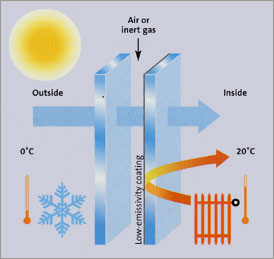
Double glazing is just two sheets of plain glass, so you can see that it also wouldn’t do anything to stop radiant heat, because the visible light passes right through, and heats up everything it lands on. But there is an air space between the two sheets, and it is this that inhibits the conduction of heat in either direction, depending on the season. The larger the air space, the better it does. You can also get the space filled with Argon gas instead of plain air, and this improves the blocking even more because Argon is an inert gas so conducts heat even less.
Low-E film filters both the UV and IR ends off the spectrum, allowing just the visible light through. This film is usually placed between two sheets of glass in a lamination – no air space. Typical domestic product is called Comfort-Plus by Pilkington and is 6.38mm thick. This does a great job of reducing the heat that radiates into your home in summer or out of it in winter, plus it chops off the UV and protects your furnishings. And being laminated, it also does a good job at sound insulation and is harder to smash through, giving a security benefit. But without the air gap, it does still conduct heat through it. And you do get a fair bit of condensation inside in winter. It is a good product, that probably gets you around 70% of the thermal performance of DG, but with added benefits of UV filter, security and is cheaper.
DG with Low-E adds to the cost, but circumvents the short-falls of plain glass DG. But it costs more.
Of course there’s also the frame. I believe around 30% of heat loss on poor windows can be through the frame – through conducting through the frame itself (aluminium frames) and through poor sealing. Next windy day, go around your house with an incense stick and you’ll be amazed at how much wind is blowing in through your frames (and exhaust fans!) – weep holes in particular. Atlas is a bit pricey – that would be because they use G James frames, which are “thermally improved”, meaning a lot of attention to sealing them up properly. This is different from “thermal break” frames, where they circumvent aluminium frames’ conduction problems by sandwiching a plastic layer between the inside and outside. I haven’t seen anyone promoting this frame type in Canberra yet. Timber frames don’t have a conduction problem, but can get a lot of gaps and leakage – especially as they age. PVC frames are good both ways, but ones I’ve seen can mark up easily and are then hard to clean. Some of the finishes are ordinary too.
In our own home design, and facing serious budget limits, I recall it being about $11,000 to trade up from the builder’s standard crappy Stegbar frames and single glass to laminated Low-E and better frames through Atlas. To add DG and Low-E was something like another $9000 on top of that. Argon gas another $2000. We went for the low-e laminated solution.
Service was woeful at Stegbar, Monaro never got back, then claimed they lost our details. Checked some PVC options, but as said, wasn’t happy with the finish. No-one knew much about their own products, and I ended up talking with a technical adviser through G James Glass in Brisbane. Moen Glass’ online information was among the best I could find.
Service was woeful at Stegbar, Monaro never got back, then claimed they lost our details. Checked some PVC options, but as said, wasn’t happy with the finish. No-one knew much about their own products, and I ended up talking with a technical adviser through G James Glass in Brisbane. Moen Glass’ online information was among the best I could find.
If you are designing from new, please be careful about your window placement. If you have massive glass expanses facing west (like a new home in Harrison facing west to Flemington Road like a bloody fishbowl), no amount of window improvement is going to stop you from baking inside in summer.
Even double glazing won’t don’t a heap of good on a west-facing window because it only addresses conducted heat. It does nothing to stop radiant heat.
You have to stop summer sun even hitting any glass wherever you can. You still need eaves on the north – at midday the sun is straight over Rockhampton (the Tropic of Capricorn remember?), meaning if you don’t have eaves, you’ll be getting sun in larger north-facing windows at the worst possible time. Awnings or eaves, plus landscaping are also critical for any windows exposed to the south-west afternoon summer sun. Obviously if windows on the east and west are smaller, they’ll also be easier to shade.
As an aside, when checking out some architects for our design, I went to see Strine. When I asked about double-glazing, she (the architect there) said “We put them on the south windows, but you don’t want them on the north windows because they stop the heat of the sun getting in in winter.” I never went back.
No comments:
Post a Comment
Please share, "Like", or comment on this post. Feedback is fuel for the blogger!