
Featuring were two incredibly bright white planets in the west-north-west sky very near the horizon, being Venus (lower and brighter) and Jupiter. Over the next few days these two beauties will get closer until on Monday and Tuesday they will be just three degrees apart. But they are low in the sky so get your cameras ready for dusk and early evening photography with a nice framing foreground, before Venus sinks too low.
 |
| http://astronomyonline.org/solarsystem/galileanmoons.asp |
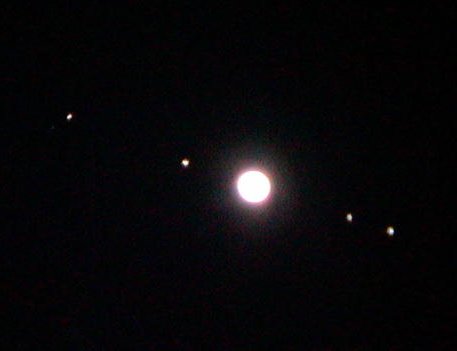
As the photos shows though - it's hard to capture the moons and Jupiter together without the planet features being washed out. You are better to get a shot with the moons looking good, and another of lower exposure of the planet, then substitute the moons into the planet photo.
Then in the east-north-east were the twin orange features of a rising full moon and Mars currently at its closest approach to Earth for two years. Mars is getting high enough in the sky now for clearer viewing. You may pick up a white ice cap if you are lucky through a scope. The full moon is less appealing viewing when full. With minimal shadowing, there is very little relief to be seen. It is also very bright and will kill off your night vision for at least 10 minutes if you view it through a telescope or camera. Our telescope has a 50mm hole to open while leaving the lid on it to reduce the moon's light to help partially alleviate this problem. But the reality is that you view the moon or everything else, but not both in one sitting. Or leave the moon until last.
 |
| http://aboriginalastronomy.blogspot.com.au /2011/07/djulpan-celestial-canoe.html |
The nebula is a dust cloud - a star factory if you like. Photos of this can be post-processed to filter out different parts of the light spectrum then coloured and recombined to give something more like you see in magazines and Hubble photos. Astronomers use this process to figure out what the dust is made of, because different molecules reflect starlight at different wavelengths. They use the same process to figure out whether exo-planets (those in other solar systems) have atmospheres.
Look for Betelgeuse too - a (clearly) red giant star that explode into a supernova any day now - well between now and the next million years...
All of these features are really easy to pick out. But if you don't know west from east (hint: west is where the sun just went down) then download a copy of Star Walk onto your smartphone. Point it in the sky and you'll see a geotracked starmap to guide you. Oh - and download a compass app too?
 |
| Click to embiggerate |
It's fun trying to track the ISS in a telescope! You can't do it with an automated one, but you can with a Dobsonian, as long as you pick it up early while it is low down so it isn't tracking across the sky quite so fast. And resist the temptation to put a high magnification eyepiece in - you'll lose it too easily. What do you see? We can pick up the shape of the solar panels easily.
Enjoy - we've waited long enough for clear air. It looks great for tonight's viewing.
No comments:
Post a Comment
Please share, "Like", or comment on this post. Feedback is fuel for the blogger!