
 |
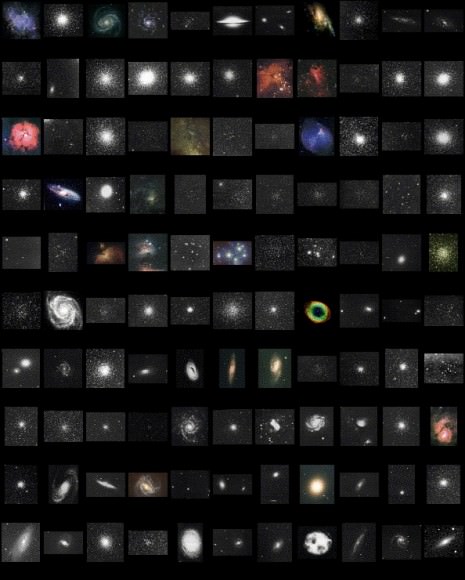
| Every single Messier Object! |
With help from his assistant Pierre Mechain, the list first had 45 objects, then eventually 103. Wikipedia tells us that others studying Messier's and Mechain's notes after his passing deduced another few objects from notations, thus taking the list up to 110. These objects are all nebulae, galaxies, and open and globular star clusters.
A very good place to start with this is the excellent listing compiled by Universe Today, with an article, photos, details and location for every object.
There are other catalogues now that are far more extensive (predominantly the New General Catalogue). But if you get to know the Messier objects and where to find them, you will be in good stead for holding your own little "star parties" for your friends, neighbours or school group. Except that is if you are in the Southern Hemisphere. Messier did his work from France, so some of the est Souther sights like the Large and Small Magellanic Clouds were invisible to him. Conversely, a number of the objects are visible in the Northern Hemisphere only, so we southern folk will get error messages if we try to send our go-to telescopes to them.
And "getting to know them" means just that - knowing how to find each one in the sky, without the aid of a computer-guided scope. This is where a simple manual Dobsonian really does help you - it forces you to learn how to locate these objects - even in poorer seeing conditions.
It will be worth learning - friends will be amazed when you whip your scope around, have a quick glance through the finder scope and in moments have it lined up on an object that is invisible to the naked eye!

 |
| M4 globular cluster |
- M4 - a globular star cluster right near the very bright star Antares.
- M6 - a quite open star cluster also known as the Butterfly Cluster, located just off the "tail" of Scorpio.
- M7 - another open star cluster also known as The Scorpion's Tail, because that's where it is too - near M6.
 |
| Trifid Nebula |
- M8 Lagoon Nebula
- M16 Eagle Nebula and open cluster
- M17 Swan Nebula
- M20 Trifid Nebula and open cluster
- M21 open cluster
- M22 globular cluster
- M23 open cluster
- M24 expansive Sagittarius Star Field and NGC 6567 planetary nebula
- M25 open cluster.
 |
| Sombrero Galaxy |
Clear skies!
No comments:
Post a Comment
Please share, "Like", or comment on this post. Feedback is fuel for the blogger!