
 |
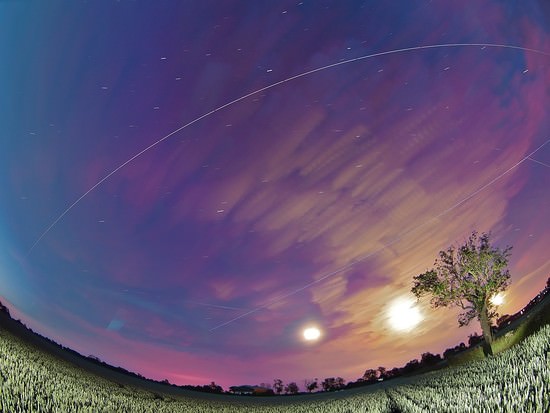
| Four ISS passes in one photo! Credit: Mark Humpage http://www.universetoday.com/86631/why-can -we-see-multiple-iss-passes-right-now/ |
There are a few long ISS passes over the next three days. Friday's pass is lower in the sky (see the maximum elevation of only 25 degrees - 90 degrees is straight up), so won't be as bright as the other two days. there are shorter passes later on some days but I've culled passes of just 1 or 2 minutes.
Date: Friday, June 01, 2012
Time: 05:36 PM
Duration: 5 minutes
Maximum Elevation: 25°
Approach: 10° above SSW
Departure: 11° above E
Magnitude: -2.1 (pretty bright)
Date: Saturday, June 02, 2012
Time: 06:18 PM
Duration: 6 minutes
Maximum Elevation: 61°
Approach: 10° above SW
Departure: 15° above NE
Magnitude: -2.9 (quite bright)
Date: Sunday, June 03, 2012
Time: 05:24 PM
Duration: 6 minutes
Maximum Elevation: 57°
Approach: 10° above SW
Departure: 10° above ENE
Magnitude: -3.2 (Very bright)
(See the scale goes backwards? It's logarithmic too, so a difference of 5 magnitudes means a brightness difference of exactly 100 times.)
(See the scale goes backwards? It's logarithmic too, so a difference of 5 magnitudes means a brightness difference of exactly 100 times.)
And on Monday, there'll be a partial lunar eclipse. The Earth’s shadow will overlap about 38% of the Moon from 19:59 to 22:06. Maximum eclipse 21:03.
 |
| The path of the Venus transit |
External ingress 8:16 - Venus touches edge of Sun
Internal ingress 8:34 - Venus completely within Sun's disc
Closest to sun centre 11:30
Internal egress 14:26
External egress 14:44 - all done
Here's hoping for clear skies, or I'll have to go for a long drive to get photos. I've been practicing with the solar filters I made for the telescope and camera - here are early efforts.
If I don't have to drive away to find clear skies, I'll be home all Transit Day. Happy for people to drop me a line about dropping around for a look through the telescope.
If you are viewing yourself, please remember it is very dangerous if you do it incorrectly. Any focusing of the sun using a lens without proper filtering will destroy your eye instantly. Here's how to watch safely:
Now for enthusiasts, here's a challenge. Iridium satellites are part of a sat-phone network. They have several shiny solar panels and cause very bright but short flares.
There are a few flares this next week but this one at Magnitude -6 will be much brighter than Venus at it brightest (-4.4), and should be right as you are walking out the office door.
Date: 6 Jun At: 17:23:40 Altitude: 70° Azimuth: 127° (SE )
Other flare details at http://heavens-above.com - log in so it knows your location for accurate predictions.
Enjoy folks!
No comments:
Post a Comment
Please share, "Like", or comment on this post. Feedback is fuel for the blogger!